
Lessons from Northern Kenya: Why Women's Livelihoods Programmes Need to Rethink Childcare
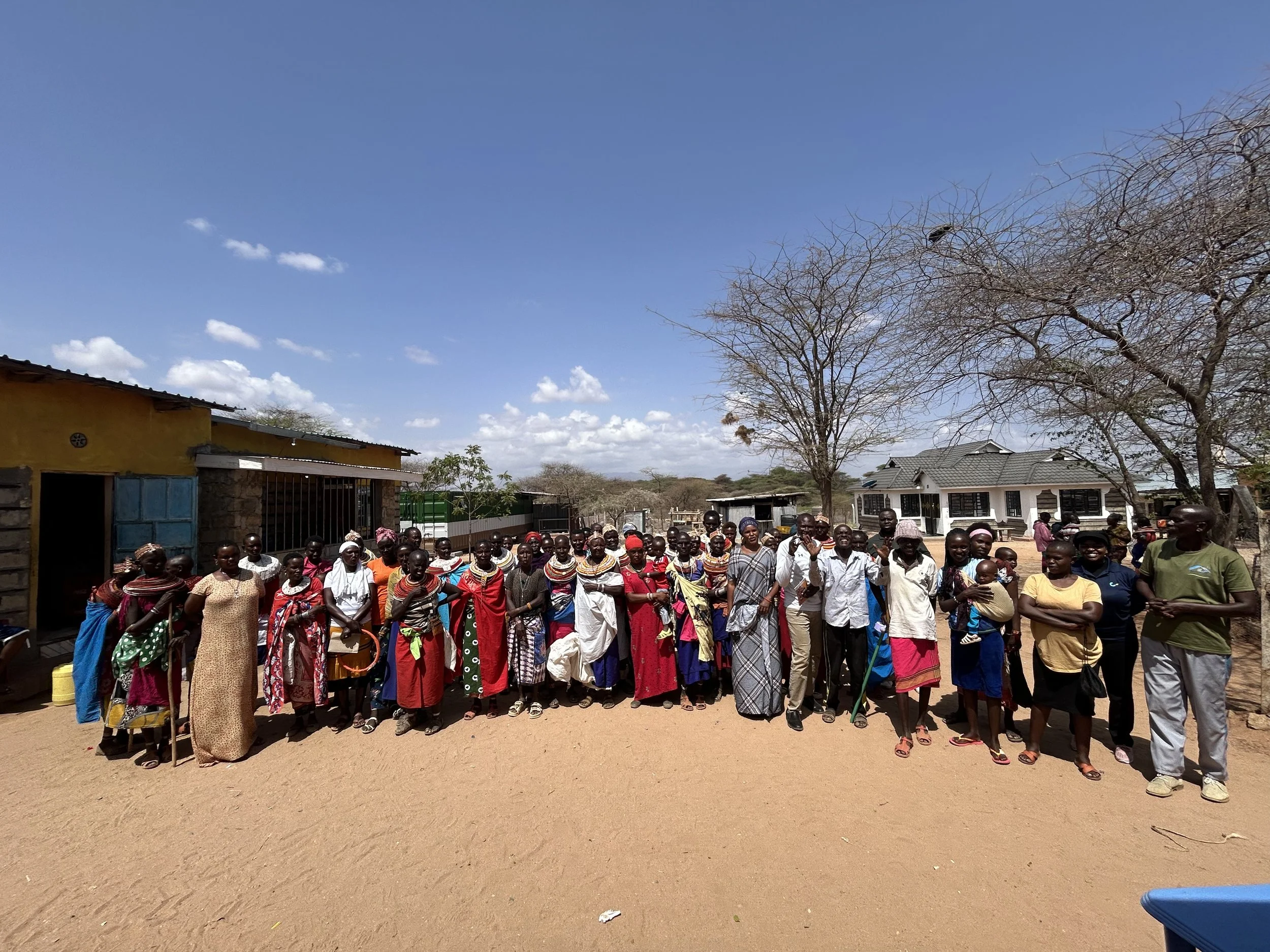
Post focus group discussion photo with the women of Malakino and Narapu self-help groups, Sereolipi, Kenya
Each morning, just before the sun crests over the parched savannah, a group of women sets out from the village of Narapu in Northern Kenya. Clad in a rainbow of brightly coloured tunics, with empty woven sacks slung over their shoulders, they are headed for the nearby acacia forest. There, they spend their days carefully extracting chunks of hardened, amber-coloured resin from the low-slung, spiny trees. The gum arabic they harvest binds, thickens, and stabilises the world's candies, soft drinks, and shampoos. But for the women here, the value is far more immediate. "I earn my own money," one collector explained.
Still, many women struggle to participate fully in the sector, with consequences for both themselves and the companies they collect for. With the support of the Conrad N. Hilton Foundation, Open Capital set out to better understand why that is.
The conversations that followed were revealing. Like women across much of the world, female resin collectors in Northern Kenya rely on an informal network of family members to care for their young children while they work: co-wives, mothers-in-law, eldest daughters. This arrangement is common, but it is also fragile. When that network is unavailable, women face a stark choice between their children and their income. A woman named Mama Sarah described the mental toll that uncertainty takes. While harvesting, "my mind is never in the forest," she said. Instead, her thoughts drifted constantly to her baby.
These conversations deepened our understanding of childcare not as one challenge among many, but as a piece of fundamental economic infrastructure. Without reliable care, the entire operation is at risk. That lesson goes much broader than this particular example. Any funder who invests in women's livelihoods without addressing childcare needs is, in essence, pouring fuel into a leaking petrol tank.
To understand why that is, let us return to that moment at sunrise in Narapu. Before the women leave for the acacia forest, they rouse their sleeping children and deposit them in the arms of their co-wives, mothers-in-law, or eldest daughters who have been pulled out of school to care for them. If no one in this invisible, informal network of caregivers is available, mothers are left with little choice. "Sometimes there is no one to look after my children, so I stay at home instead of going to work to take care of them," one woman explained. That economic cost is borne silently and never counted.
The resin collectors we spoke to told us this is how things have always been. But that does not mean they accept it as inevitable. It was Acacia EPZ (the gum arabic exporter that works directly with these women and has championed their economic inclusion from the start) that first brought this challenge to our attention and encouraged us to look for a solution together. Working closely with Acacia EPZ and the women themselves, we co-designed a pilot for a system of reliable, structured, and paid daycare: something these communities had never had access to before. Mothers were on board immediately. "It is a good initiative that would solve some of the challenges we face… and our children would be safe," one woman told us.
This upcoming pilot reflects our core belief that sustainable models are built from within, rather than imposed from the outside. Women in the villages are responsible for selecting those in their communities who will be trained as professional caregivers. These caregivers will provide care and nutritious meals each day while their fellow mothers are working. Mothers will contribute a small daily amount towards the cost of the service, calibrated to what is affordable in their context. Meanwhile, purpose-built local savings groups will house additional funds that can support the childcare centres in lean economic times when mothers are unable to pay.
The initial pilot will run for six months, with the goal of demonstrating that this self-sustaining, community-owned model is viable and can be scaled beyond these villages. Even before it has begun, we can already see how readily these communities have embraced the idea. That reinforces what the women told us on day one: that reliable, good-quality childcare is a need, and not just a want.
What we learned from these experiences has been our own call to action, and we hope it will be yours too. For businesses, conservancies, and employers working with women in Kenya's Arid and Semi-Arid Land (ASAL) regions, we hope our work makes clear that childcare is a foundational piece of workplace infrastructure for pastoralist communities — not a welfare add-on. Meanwhile, if you are a development actor looking to establish or expand a presence in Northern Kenya, we would welcome a conversation about how community-led childcare can be integrated into your programme design from the outset.
The applicability of what we have learned also extends far beyond this slice of Northern Kenya. Across companies and value chains, having a safe, reliable place to care for children is a precondition for women's full economic participation. It is an enabler that determines whether women can thrive within a programme. For this reason, it cannot be treated as an afterthought in programmes that invest in women's livelihoods, financial inclusion, and economic empowerment. Instead, childcare must be part of the theory of change, and placed front-and-centre in programme design. Prioritising care in this way is not charity. When women thrive, so do the societies they live in and the businesses they work for.
As the Hilton Foundation's Early Childhood Development Lead for East and Southern Africa, Lilies Njanga, puts it: "childcare is a smart investment. Quality, community-led childcare services enable women to fully participate in economic opportunities and support themselves and their young children. Investing in models like Open Capital's childcare pilot project ensures that young children are healthy, developing and learning."
